Get clarity with OCT for LM and bifurcation treatment
European Bifurcation Club 2019, EBC 2019 - Barcelona, Spain ABBOTT SYPOSIUM Get clarity with OCT for LM and bifurcation treatment - Introduction Author: Thierry Lefevre, MD, ICPS, France


European Bifurcation Club 2019, EBC 2019 - Barcelona, Spain ABBOTT SYPOSIUM Get clarity with OCT for LM and bifurcation treatment - Introduction Author: Thierry Lefevre, MD, ICPS, France

European Bifurcation Club 2019, EBC 2019 - Barcelona, Spain BENCH & COMPUTATIONAL BIFURCATION STENT SIMULATIONS Computational hemodynamics in patient specific stented bifurcations reconstructed from intravascular imaging Author: Claudio Chiastra, MD, Politecnico di Torino, Italy CONCLUSION 3D reconstruction of stented coronary bifurcation models from OCT and angiography (or CT) --> Highly-detailed patient-specific CFD analyses Open issues 3D reconstruction CFD simulations --> Application to large clinical datasets still require a reliable, very fast methodology
European Bifurcation Club 2019, EBC 2019 - Barcelona, Spain BENCH & COMPUTATIONAL BIFURCATION STENT SIMULATIONS DK Crush vs tap. In vitro comparison of thrombogenicity and flow Author: Valeria Paradise, MD, Maasstad Hospital, Rotterdam, The Netherlands OBJECTIVE The purpose of the present study was to compare DKC vs TAP technique to evaluate their different effects in terms of strut apposition and thrombus formation in in-vitro models using OCT and computational flow reconstruction. METHODS N= 12 stents in total (Synergy n=6 and Ul(master=6) Bifurcation y-shaped model Stent with same platform were deployed using TAP or DKC technique Final POT was performed for all the experiments OCT pullback was performed from MV and SB before and after POT A peristaltic pump was used to perfuse the porcine blood through the silicone model at a flow rate of 200ml/min for 4 minutes Thrombus area was calculated from OCT pullback after perfusion CONCLUSION No difference in terms of stent struts apposition Similar acute thrombus formation POT significantly reduces EI Even when performed in silicon model, these procedures are associated with stent malapposition
European Bifurcation Club 2019, EBC 2019 - Barcelona, Spain CORONARY BIFURCATION IMAGING Algorithm when to perform OCT to optimize efficiency can we overcome OCTS limitations Author: Takayuki Okamura, MD, Yamaguchi University Hospital, Japan SUMMARY Pre-procedure OCT assessment in the main vessel provides useful information for bifurcation stenting. However, ostial assessment is fundamentally impossible, a potential disadvantage compared to IVUS, and more contrast media is used. Some ingenuities may overcome them. The biggest advantage of OCT compared to IVUS would be the guidance of the position of the guidewire into the jailed side branch when the side branch dilatation is performed. Further studies whether OCT guidance can improve clinical outcomes would be needed.

European Bifurcation Club 2019, EBC 2019 - Barcelona, Spain CORONARY BIFURCATION IMAGING Impact of Bifurcation Angle on Incomplete Stent Apposition Author: Masahiro Yamawaki, MD, Saiseikai Yokohama City Eastern Hospital, Japan PURPOSE To investigate the impact of the “Link free and distal re-wiring(LFD)” condition and bifurcation angle on 9-month OCT findings after 1-stenting with final kissing inflation(FKI). CONCLUSION High bifurcation (>55°) angle should be care in case of link-free on carina and distal wiring , due to uncorrected stent distortion on the opposite of side branch (SB) and distal main vessel (MV) by final kissing balloon inflation (FKI), but incomplete stent apposition (ISA) in MV decreased after 9 months Impact of bifurcation angle on 9-month OCT data was minor than those of “link and re-wire position” before FKI in this registry. FKI with optimal condition under 3D-OCT guidance reduced uneven neointima proliferation, ISA and uncovered strut after 9 months. Further study is required to demonstrate clinical impact of OCT guided bifurcation treatment.
European Bifurcation Club 2019, EBC 2019 - Barcelona, Spain CORONARY BIFURCATION IMAGING Imaging-guided rewiring in bifurcation : 2D and 3D OCT Author: Ryoji Nagoshi, MD, Osaka Saiseikai Nakatsu Hospital, Japan OBJECTIVE The aim of the study is to assess the impact of 3D-OCT on the procedures for bifurcation stenting including the guide wire (GW) distal rewiring rates. SUMMARY The rate of the distal GW rewiring can be higher by referring to the 3D image than only with the 2D image. The stent link loca0on over Sb orifice is important. The optimal GW rewiring position may depend on the stent link location over carina. In the LC type, it is better to consider the difference of the GW rewiring position in not only the longitudinal but also the short axis directions. CONCLUSION Three-dimensional OCT is useful for the attainment of the GW distal rewiring and provides the important information of the stent link location which cannot be revealed by the other intravascular imaging modalities.
European Bifurcation Club 2014 - EBC 2014 - Bordeaux, France Bifurcation stenting: learning from bench and simulation Flow Modeling based on 3d oct reconstructions Author: Gabriele Dubini, MD, Politecnico di Milano, Italy AIM Development of an automated reconstruction method of a stented coronary bifurcation model starting from OCT images Construction of a 3D model of the bifurcation to perform a Computational Fluid Dynamic (CFD) simulation and calculate hemodynamic quantities related to restenosis CONCLUSION An automated reconstruction method of an in-vitro stented coronary bifurcation model starting from OCT images was developed The 3D geometry obtained from this reconstruction method can be used to perform CFD simulations to quantify hemodynamic variables related to restenosis on the basis of OCT exams, to predict the regions with the highest risk of restenosis
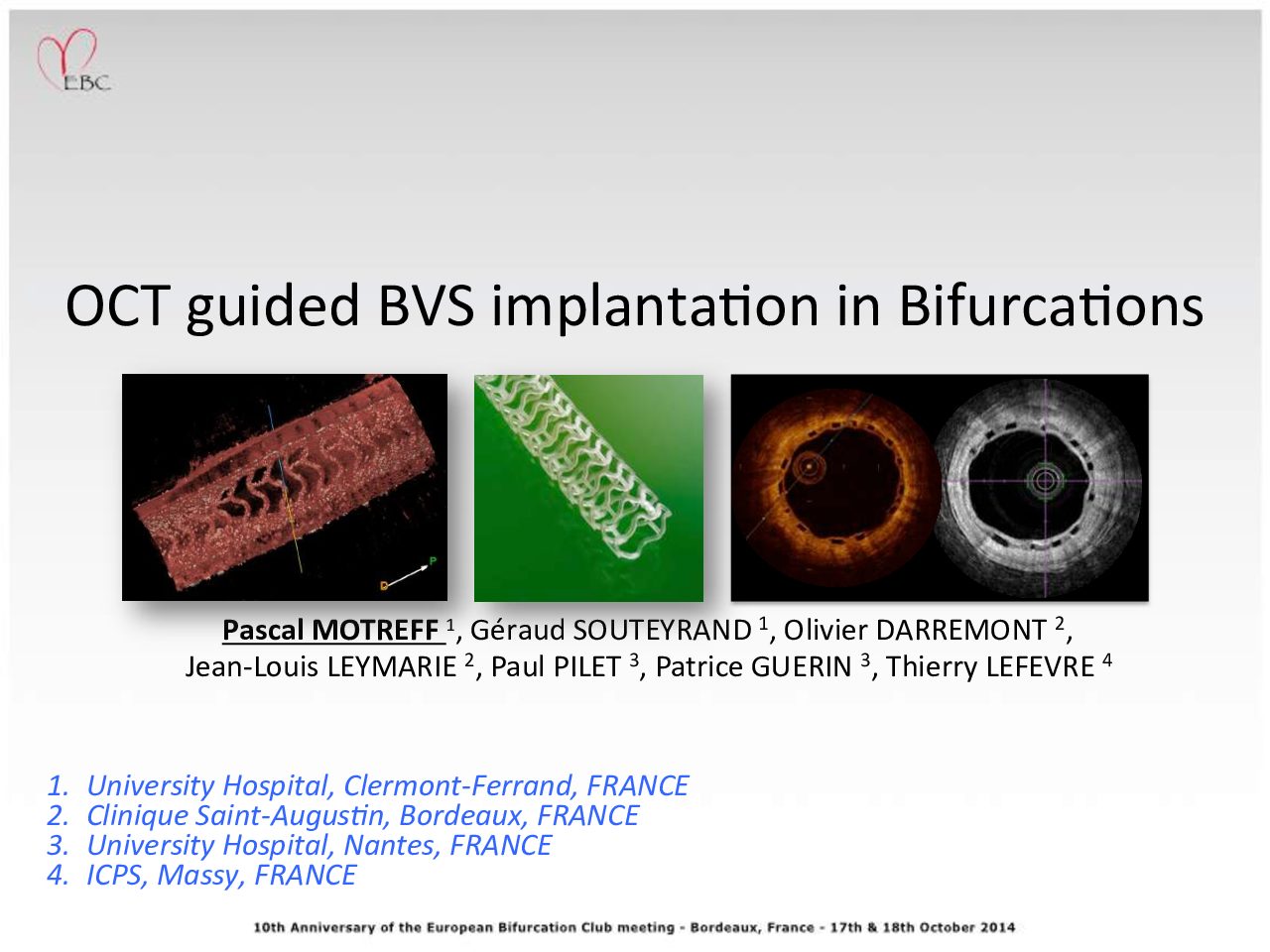
European Bifurcation Club 2014 - EBC 2014 - Bordeaux, France Live bifurcation stenting guidance: OCT, IVUS, FFR & ANGIO OCT guided BVS Implantation Author: Pascal Motreff, MD, University Hospital, Clermont-Ferrand, France

European Bifurcation Club 2014, EBC 2014 - Bordeaux, France LIVE BIFURCATION STENTING GUIDANCE: OCT, IVUS, FFR & ANGIO Side Branch Evaluation by OCT Author: Niels Ramsing Holm, MD, Aarhus University Hospital, Denmark CONCLUSION Do not advance an imaging wire into a jailed SB Observe imaging depth evaluating SBs by MV 3D-OCT SB pullback for full evaluation of two-stent techniques Adjustable 2D measurement planes may be new standard in ostial assessment Do not advance an imaging wire into a jailed SB Observe imaging depth evaluating SBs by MV 3D-OCT SB pullback for full evaluation of two-stent techniques Adjustable 2D measurement planes may be new standard in ostial assessment
European Bifurcation Club 2014, EBC 2014 - Bordeaux, France LIVE BIFURCATION STENTING GUIDANCE: OCT, IVUS, FFR & ANGIO OCT in assessment of stent failure at the bifurcation level Author: Tom Adriaenssens, MD, PhD, University Hospitals Leuven, Belgium CONCLUSION Bifurcation PCI treated segments do not constitute a majority of cases with ST in the Prestige OCT registry (16/230) Inclusion bias possible (more severe cases did not make it to the cath lab/did not undergo OCT during PCI) Problems of thrombus around floating struts and UC/MA/overlap in remote areas but related to bifurcation PCI technique predominant